What Happens if You Only Drink Meal Replacement Shakes? Is It Safe?
Chris ManderinoShort answer: drinking only meal replacement shakes can work for a short, specific purpose, like a supervised pre-surgery diet, but it isn't a smart long-term plan. You lose the fullness that comes from chewing real food, the variety of whole foods, and the social side of eating. The better use is one shake a day in place of the meal you'd otherwise skip or grab on the run.
I worked at Bariatric Advantage, a nutrition company built for weight-loss surgery patients. I've seen where all-liquid diets make sense and where people take them too far.
Chris Manderino, founder of LyfeFuel. Former NFL fullback, formerly at Bariatric Advantage.
Where shake-only diets actually make sense
The clearest case I know is surgery. At Bariatric Advantage, a meal replacement protocol became standard care for many patients before laparoscopic weight-loss surgery. Surgeons need to shrink the liver before they operate, and a large liver is one of the main reasons a minimally invasive procedure has to be converted to open surgery. A short, structured, shake-based diet before the operation became a staple in most bariatric practices.
After surgery, shakes matter again. Meal sizes are much smaller and the anatomy has changed, so getting adequate protein plus a full range of vitamins and minerals from food alone is hard. Shakes help close that gap.
Notice what those cases have in common: a specific goal, a set timeframe and medical supervision. That's very different from deciding to drink every meal indefinitely.
What happens if you only drink meal replacement shakes?
Short term, a fixed menu of shakes makes calories predictable and removes a lot of food decisions. If the shake is nutritionally complete, a few days or weeks is generally fine for most healthy adults.
Long term, the problems pile up:
- You miss the satiety of real food. Chewing and eating whole food is a big part of feeling satisfied. Drinking every meal takes that away, and a lot of people end up hungry, bored or snacking.
- You lose variety. Whole foods bring fiber, phytonutrients and a range of nutrients no single formula fully replicates.
- Eating becomes isolating. Meals are social. A liquid-only routine is hard to keep up around family, friends and work.
- Calories can get too low. Several shakes a day can land well below what an active body needs. Here's how low is too low for a meal replacement shake.
The tech world went through a phase of treating meal replacements as a replacement for food altogether. I think most people have since realized that isn't the ideal approach, and I agree.
Is it safe to only drink meal replacement shakes?
For a short period with a complete formula, generally yes for healthy adults. Very low-calorie, shake-only plans should be done with a doctor, which is how they're used in clinical settings. As your everyday, indefinite way of eating, I don't recommend it. If you have a medical condition, are pregnant, or take medication, talk to your doctor before replacing multiple meals.
What a shake is actually good for
A shake should never be the whole answer. But it's great at a few things:
- Convenience. It's there when you have two minutes and no plan.
- Beating the typical grab-and-go breakfast. A lot of convenient breakfast foods are loaded with sugar. A good shake can be a better way to start the day.
- A rounded macro profile in one place. Protein, carbohydrates and some fat together, plus essential vitamins and minerals.
- Nutritional insurance. On days your meals aren't perfect, it helps you cover the basics.
How to use meal replacement shakes the right way
1. Replace one meal, two at most. Breakfast or a post-workout lunch are the easiest. Customers tell us one shake keeps them full until lunch.
2. Eat real food the rest of the day. Chew your other meals. Get your vegetables, fruit and whole grains from food.
3. Check the label. Look at the protein source, the sweeteners and the added sugar, not just the calories.
4. Use all-liquid plans only for a defined purpose, ideally with medical guidance.
What's in the LyfeFuel Essentials Shake
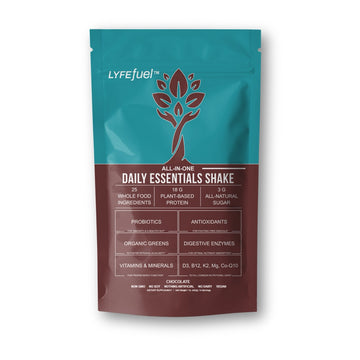
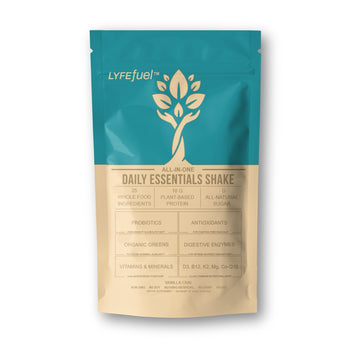
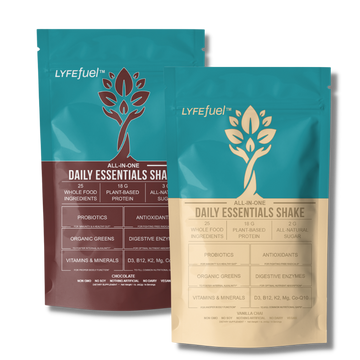
I built Essentials as a shake you'd use for one meal a day, not as a substitute for food. One scoop contains 18g of pea and organic rice protein, 110 calories, real whole foods like an organic greens blend and a berry blend, plus 27 essential vitamins and minerals, a digestive enzyme blend and 5 probiotic strains. No whey, dairy or soy, and sweetened with organic coconut sugar and stevia (3g added sugar in chocolate, 1g in vanilla).
Start by swapping one meal a day. See what's in one scoop of the Essentials Shake, or browse all meal replacement shakes.
Related Articles
Frequently Asked Questions
Can you live on meal replacement shakes forever?
It isn't recommended. Shakes can't replace the satiety of chewing real food or the variety of whole foods, and an all-liquid routine is hard to sustain. Use them for one or two meals a day alongside real food.
How long is it safe to only drink meal replacement shakes?
A few days to a few weeks on a nutritionally complete shake is generally fine for most healthy adults. Longer or very low-calorie shake-only plans should be done under medical supervision, the way they are used before bariatric surgery.
Why do bariatric patients use meal replacement shakes before surgery?
Many bariatric programs use a short, shake-based diet before laparoscopic surgery to help reduce liver size, because a large liver can make the minimally invasive approach harder. After surgery, shakes help patients get enough protein and micronutrients while meal sizes are small.
What is a meal replacement shake good for?
Convenience, a better option than many sugary grab-and-go breakfasts, a rounded mix of protein, carbohydrates and fat in one serving, and covering your basic vitamins and minerals on days your meals fall short.
Are all meal replacement shakes the same?
No. Protein source, sweeteners, added sugar, calories and vitamin and mineral content vary widely. Read the full label, not just the front of the bag.