Nutritional Meal Replacement Shakes: What "Nutritionally Complete" Actually Means
A nutritional meal replacement shake is marketed as covering the vitamins, minerals, protein and calories of a meal, but "nutritionally complete" is a marketing phrase, not a regulated standard, so the label is the only place to verify it. Reading the Supplement Facts panel the right way, and knowing what a shake structurally cannot do that whole food does, is what separates a genuinely useful shake from one that just sounds complete.
Shop the Essentials range
View all products →
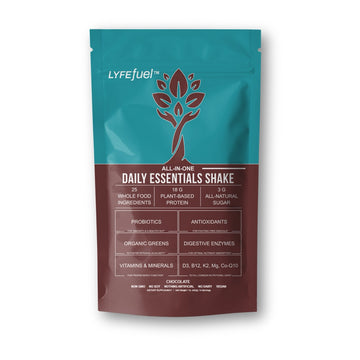
Essentials Shake
Chocolate · 24 servings
★★★★★★★★★★ 4.63 (1566)

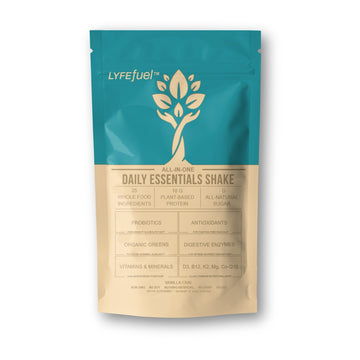
Essentials Shake
Vanilla Chai · 24 servings
★★★★★★★★★★ 4.63 (1566)

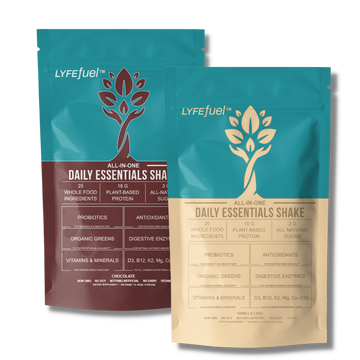
Essentials Bundle
2x Vanilla · free shaker
★★★★★★★★★★ 4.63 (1566)
Key Takeaways
- "Nutritionally complete" is not a legal or regulated term. No agency verifies it before a brand prints it on a label.
- A real micronutrient panel names each vitamin and mineral with its amount. A proprietary blend hides the amounts behind a single total.
- Most micronutrient premixes in this category, including synthetic and whole-food-based ones, are legitimate ways to deliver vitamins. Neither is inherently better, and a shake calling its synthetic premix "food-based" is the claim to watch for.
- Vitamins A, D, E and K need dietary fat to absorb. A low-fat shake needs fat added, or those vitamins pass through mostly unused.
- No shake replicates the food matrix: the fiber diversity, the chewing, and the way nutrients behave when they arrive packaged inside a plant cell instead of isolated in a powder.
What "nutritionally complete" actually means, and who checks it
"Nutritionally complete" implies a product covers every nutrient a body needs across a meal or a day. In practice, it is a phrase a brand chooses to print, not a certification anyone issues. There is no government agency or third-party body that reviews a shake's formula and signs off on completeness before the word goes on the package.
That does not make the phrase meaningless, but it does mean the burden of proof sits entirely on the label. A shake can call itself nutritionally complete with a 20-item vitamin and mineral panel, or with three ingredients and a marketing paragraph. Both are legal. Only one gives you anything to check.
The useful move is to stop reading the front of the package and go straight to the Supplement Facts panel and the ingredient list. That is where the actual claim gets tested: how many vitamins and minerals are listed, at what amount, and whether the calories, protein and fat around them add up to something that could plausibly stand in for a meal.
It helps to think of "nutritionally complete" as a spectrum rather than a checkbox. A shake with 20-plus named vitamins and minerals, meaningful protein, some fat and at least a few grams of fiber sits at one end. A shake with a handful of nutrients padded out by flavoring and a proprietary blend sits at the other. Both can use the same three words on the front. Only the panel tells you which one you are actually buying.
How to read the micronutrient panel: named amounts vs. proprietary blends
Two shakes can both say "packed with vitamins and minerals" and mean very different things. The panel tells you which one you are holding.
Named amounts. A properly disclosed panel lists each vitamin and mineral individually, with a specific amount and usually a percent daily value. Vitamin A: a number. Vitamin D: a number. Zinc, magnesium, B12, each with its own line. This is the format that lets you actually compare products or check whether you are getting too much of something you are already supplementing elsewhere.
Proprietary blends. The other format bundles a group of ingredients under one name, such as "vitamin and mineral complex, 500mg," with no breakdown of how much of that 500mg is any individual nutrient. This is common with blends of botanicals and superfoods too. It is not necessarily dishonest, but it is not verifiable. You cannot tell if a proprietary greens blend is mostly spirulina with a trace of everything else listed, because the label does not have to say.
When you are comparing shakes, the panel format is as informative as the ingredient list itself. A shake that names every vitamin and mineral by amount is giving you the information to judge it. A shake that hides the same ingredients inside a blend total is asking you to trust the front label instead.
The same logic applies to the botanical and superfood additions many shakes include, things like greens blends, berry blends or probiotic strains. A panel that names each one, with its own milligram amount or CFU count for a probiotic blend, lets you actually evaluate the dose. A single combined total tells you the shake contains these ingredients, but not in what proportion, which makes it impossible to judge whether any one of them is present in a meaningful amount or a token one.
Synthetic vs. whole-food nutrient forms, explained honestly
This is the part of the label most shakes gloss over, and it is worth being precise about rather than picking a side.
Most micronutrient premixes used across the meal replacement category, including in many shakes that market themselves as clean or natural, are synthetic isolates: forms like retinyl palmitate for vitamin A, ergocalciferol or cholecalciferol for vitamin D, ascorbic acid for vitamin C, cyanocobalamin for B12. These are manufactured compounds, not extracted from food. That is standard practice, not a defect. Synthetic vitamin forms are well studied, stable in a powder, and inexpensive enough to make a broad panel affordable to include at all.
A smaller number of brands use water-extracted or whole-food-derived vitamin forms, grown from yeast, algae or produce and then concentrated. These exist and are real, but they are less common, typically cost more, and are not yet the standard across most shakes on the market, including some that are still transitioning their formulas toward them.
The claim to watch for is a shake that markets its vitamin panel as "food-sourced" or "whole-food" when the actual premix is synthetic. If a label doesn't specify the form of a vitamin, or lists it as part of a general "blend," that is the moment to ask which kind you are getting. Reading the parenthetical after each vitamin name, where the label provides it, is the only reliable way to know.
Neither form is automatically superior for absorption in a healthy adult without a specific deficiency or malabsorption condition, and neither claim should be taken at face value without the panel to back it up.
Fat-soluble vitamin absorption needs dietary fat
Vitamins A, D, E and K are fat-soluble, which means your body absorbs them through the same pathway it uses to absorb dietary fat. If a shake carries a full panel of these vitamins but is itself very low in fat, and you drink it with water alone, a meaningful share of those vitamins is likely to pass through largely unabsorbed rather than reaching your bloodstream.
This is a mechanical fact about digestion, not a flaw specific to any one product. It applies to any low-fat shake, regardless of how complete its panel looks on paper.
The fix is simple and does not require a different shake: add a source of fat when you drink it. A tablespoon of nut butter, a quarter of an avocado, whole milk instead of water, or a spoon of ground flax or chia all work. If your shake is built around 2 to 5 grams of fat per serving, treat that as a base you are meant to build on rather than a finished formula, and plan the fat addition the same way you would plan the protein source.
What a shake cannot replicate from whole food
Even a shake with a fully disclosed, generous micronutrient panel is still a powder, and there are things a powder cannot do that a plate of food does.
The food matrix. Nutrients in whole food do not exist in isolation. They are embedded in a plant's cell structure alongside fiber, water and hundreds of other compounds, and that structure affects how and how fast nutrients are released during digestion. Extracting a vitamin or mineral into a powder and isolating it changes that release pattern. This is one reason nutrition researchers are cautious about assuming an isolated nutrient behaves identically to the same nutrient eaten inside food.
Fiber diversity. Whole meals bring many different types and sources of fiber at once, from vegetables, whole grains, legumes and fruit, each of which feeds different populations of gut bacteria. A shake, even one that includes fiber, is delivering a narrower slice of that diversity than a varied plate of food does.
Chewing. Digestion starts in the mouth, and chewing triggers satiety signals and digestive enzyme release that a shake you drink in 90 seconds does not fully replicate. This is a real, well-established mechanical difference, and it is part of why liquid meals tend to feel less satisfying calorie for calorie than solid food, independent of what is in them.
None of this means a shake is a poor choice for the meal it is actually replacing, whether that is a skipped breakfast or a desk lunch eaten at your keyboard. It means a shake works best as a genuine substitute for a specific meal you would otherwise skip or eat poorly, not as a wholesale replacement for eating food, and one to two shakes a day with the rest of your meals intact is a reasonable ceiling for most people.
It also means the fastest way to close the gap between a shake and a meal is not to find a more expensive shake, but to add the things a shake structurally leaves out. A piece of whole fruit adds fiber diversity and chewing. A spoon of nut butter or seeds adds fat for absorption. Neither costs much, and both do more for how complete the meal actually is than another line item on the vitamin panel.
If you are pregnant, managing a medical condition, taking prescription medication or on a GLP-1 medication, talk to your doctor or a dietitian before making any shake, regardless of brand, a daily habit. Some micronutrient levels can matter alongside other supplements you take.
LyfeFuel Essentials measured against these criteria
Here is our own shake held up against the panel-reading and nutrient-form questions above, plainly, including what does not look great.
- Panel disclosure: 27 vitamins and minerals are listed by name and amount on the Supplement Facts panel, not folded into a single blend total. The whole food ingredients, spirulina, flax, grape seed, pomegranate and the rest, are also each named individually with their own milligram amounts.
- Nutrient form: the vitamin and mineral premix is a standard synthetic blend, the same category of forms used across most of this market. We are not going to call it food-sourced or whole-food, because it is not, and that distinction matters to us more than it costs us to admit. A water-extracted premix is in development for our next formulation and is not shipping yet, so we are not claiming it early.
- Fat and absorption: 2 grams of fat per 33g scoop, which is low. If you care about absorbing the fat-soluble vitamins on our panel, blend it with milk, nut butter or another fat source rather than water alone.
- Calories: 110 per scoop. That is a base to build a meal around, not a complete meal by itself.
- Fiber: 1 gram in the shake. Low, and we would rather say so than dress it up. Our Essentials Bars carry 12 to 14 grams of fiber if that is what you are trying to add.
- Protein: 18g from Canadian yellow pea and organic rice protein, a complementary pairing that covers the amino acid gaps either has alone.
- Reviews: 4.63 average across 1,514 Judge.me reviews, which we think is honest ground for a shake this size to stand on. The live rating on the page updates itself rather than being a number we typed in.
Frequently asked questions
Is "nutritionally complete" a regulated claim?
No. There is no government agency or third-party body that reviews a shake's formula before a brand is allowed to print "nutritionally complete" on the label. The only way to verify the claim is to read the Supplement Facts panel yourself.
What's the difference between a named vitamin amount and a proprietary blend?
A named amount lists each vitamin or mineral individually with its own quantity and percent daily value, so you can check exactly how much you are getting. A proprietary blend groups several ingredients under one total weight with no breakdown, which makes it impossible to verify how much of any single nutrient is actually in there.
Are synthetic vitamins worse than whole-food vitamins?
Not automatically. Synthetic isolates such as ascorbic acid or cyanocobalamin are well studied, stable and used across most of the meal replacement category, including by brands that don't advertise it. Whole-food-derived vitamin forms exist and are less common and typically cost more, but neither form is proven superior for absorption in a healthy adult without a specific deficiency.
Why does fat matter for a shake's vitamin panel?
Vitamins A, D, E and K are fat-soluble, meaning your body absorbs them through the same pathway as dietary fat. A shake low in fat, drunk with water alone, means a meaningful share of those vitamins may pass through largely unabsorbed. Adding a fat source like nut butter, milk or avocado fixes this.
Can a shake fully replace whole food long-term?
Not as a wholesale strategy. Whole food brings fiber diversity from many different sources, a food matrix that affects nutrient release, and chewing, which triggers digestive and satiety signals a shake does not replicate. One to two shakes a day alongside regular meals is a reasonable ceiling for most people.
Does a low-fiber shake mean I'm not getting fiber at all?
It means that specific shake is not your fiber source. Check the fiber line on the panel directly rather than assuming a shake covers it because it covers other nutrients. If it's low, add fruit, oats or a fiber-forward food alongside it.
Should I check the vitamin form before buying a shake?
Yes, if it matters to you. Look at the parenthetical next to each vitamin name on the panel where it's provided. That tells you whether you're looking at a synthetic isolate or a different source, rather than relying on front-of-package language like "whole-food" or "natural," which is not a verified claim.