GLP-1 and Nutrition: The Deficiency Problem Nobody's Talking About
Chris ManderinoThis article is for informational purposes only and does not constitute medical advice. Always consult your healthcare provider before making changes to your supplement regimen.
I spent years working for Bariatric Advantage, the leading nutrition provider for bariatric surgery patients. Long before Ozempic and Wegovy existed, bariatric surgery was the primary treatment for morbid obesity and severe Type II diabetes. Our company existed for one reason: food alone wasn't enough for these patients. After surgery, their reduced intake created serious nutritional gaps that had to be filled deliberately.
What I saw, traveling the country educating physicians, their staff, and their patients, was a clear pattern. The patients who stuck to a structured supplement routine had significantly better outcomes. Better body composition. Fewer adverse nutrition-related events. More energy. The patients who thought surgery alone was enough, who didn't make real lifestyle or dietary changes, struggled.
I also heard the same request, over and over: "Is there a simpler way to do this? I don't want to take a dozen different pills and powders every day."
That request is what eventually led to LyfeFuel. Complete nutrition, macros and micros, in highly bioavailable forms that this population needs to achieve healthy, sustainable fat loss without the undesirable side effects.
Now we're watching the same story play out at a massive scale with GLP-1 medications. Different mechanism, same fundamental problem: when you eat significantly less, you get significantly fewer vitamins, minerals, and protein. And your body keeps the score.
A 2026 review published in Clinical Obesity, covered by Harvard Health Publishing, examined six studies involving 480,825 adults on GLP-1 therapy. The researchers concluded that micronutrient deficiencies are "a common consequence rather than a rare adverse effect" of GLP-1 treatment.
The short version: The same nutritional challenges I spent years solving for bariatric patients are now affecting millions of GLP-1 users. And most of them don't know it yet.
What the Research Actually Shows
The data is clearer than most people realize.
Over 1 in 5 GLP-1 users develop a diagnosed nutrient deficiency within a year
The largest study, a claims analysis of 461,382 GLP-1 users published in Obesity Pillars, found that 12.7% were diagnosed with a nutritional deficiency within 6 months of starting treatment, rising to 22.4% within 12 months (Butsch et al., 2025).
Those are diagnosed cases, people who showed up on a lab test. The actual number walking around with subclinical deficiencies is almost certainly higher.
The deficiencies follow a pattern
Across the research, the same nutrients keep appearing:
| Nutrient | What the Research Found | Why It Matters |
|---|---|---|
| Vitamin D | Most common deficiency: 13.6% of GLP-1 users at 12 months. 49% higher risk vs. other diabetes drugs. Only 1.4% met recommendations. | Supports bone health, immune function, and muscle performance. Deficiency accelerates bone loss during rapid body composition changes. |
| Iron | 26–30% lower ferritin levels. Markedly reduced intestinal iron absorption after just 10 weeks on semaglutide. Over 60% consumed below requirements. | Critical for energy, oxygen transport, and cognitive function. Low iron means fatigue, brain fog, and anemia risk. |
| B Vitamins | B vitamin deficiency increased over time on GLP-1 therapy. Case reports linked GLP-1 use to severe thiamine deficiency, including Wernicke encephalopathy. | B12 supports energy and nerve function. Thiamine deficiency can cause serious neurological problems. |
| Calcium | 72% of GLP-1 users consumed less than recommended amounts. Combined with low vitamin D, creates conditions for accelerated bone loss. | Essential for bone density, especially critical during rapid body composition changes when bone remodeling accelerates. |
| Protein | Only 43% met minimum protein recommendations (1.2 g/kg/day). Up to 40% of mass lost on semaglutide was lean muscle, not fat. | Protein preserves muscle. Without enough, your metabolism slows and the weight comes back. |
| Magnesium, Zinc, Potassium | GLP-1 users consistently fell short of requirements for these minerals. | Support muscle function, immune health, heart rhythm, and hundreds of enzymatic processes. |
Sources: Urbina et al., Clinical Obesity (2026); Butsch et al., Obesity Pillars (2025); Johnson et al., Frontiers in Nutrition (2025)
It's not just about eating less. Absorption changes too.
GLP-1 medications don't just reduce your appetite. They slow gastric emptying, which is how fast food moves through your stomach. This alters how well your body absorbs certain nutrients, particularly iron and B12.
So even if you're eating nutrient-dense food, your body may not be extracting as much from it. Less going in, and less being absorbed from what does go in. It's a double hit.
The Real Goal Is Fat Loss, Not Just Weight Loss
This is where my bariatric experience becomes directly relevant. I watched this play out for years: patients who lost weight without proper nutrition didn't just lose fat. They lost muscle. And that distinction changes everything.
Research from the STEP 1 trial found that roughly 40% of the mass lost on semaglutide was lean tissue, not fat. For someone who drops 30 pounds, that could mean 12 pounds of muscle gone.
Why this matters more than the scale suggests:
- ❌ Muscle drives your metabolism. Less muscle means fewer calories burned at rest, which means easier regain when you eventually come off the medication.
- ❌ Muscle protects your bones. Combined with calcium and vitamin D deficiency, losing lean mass creates compounding risk for bone health.
- ❌ Muscle is what gives your body the result you actually want. The goal isn't a lower number. It's a healthier composition.
The 2025 joint advisory from the American College of Lifestyle Medicine, the American Society for Nutrition, the Obesity Medicine Association, and The Obesity Society specifically recommends 1.2–2.0 grams of protein per kilogram of body weight per day for people on GLP-1 therapy. That's significantly higher than the general population recommendation.
For a 170-pound person, that translates to roughly 93–154 grams of protein daily. When your appetite has essentially been switched off, hitting that number through food alone feels close to impossible.
This is the same challenge bariatric patients faced. The ones who addressed it proactively, the ones who took their nutrition seriously, had dramatically better outcomes. The ones who didn't, lost muscle, lost energy, and often regained the weight.
The Cost Equation
GLP-1 medications already run $8,000–$9,000 per year at U.S. commercial net prices, and up to $1,349 per month before insurance. A Cleveland Clinic study found that 47.6% of people who stopped their GLP-1 cited financial reasons as the primary driver.
On top of the drug itself, many GLP-1 users are told they need separate supplements:
| Supplement | Typical Monthly Cost |
|---|---|
| Protein powder | $30–60 |
| Multivitamin | $15–30 |
| Vitamin D3 | $10–15 |
| Iron supplement | $10–15 |
| B-complex or B12 | $10–20 |
| Collagen peptides | $25–40 |
| Magnesium | $10–20 |
| Electrolytes | $20–35 |
Total: $130–$235/month. On top of the medication. On top of the doctor visits. On top of the blood work.
This is the supplement cabinet problem all over again: eight bottles, eight price tags, and the lingering question of whether your body is actually absorbing any of it.
Sound familiar? It's the exact frustration I heard from bariatric patients for years.
What to Look For in GLP-1 Nutrition Support
If you're on a GLP-1 medication, your nutritional strategy should address three things:
1. Adequate protein to preserve lean mass
This is non-negotiable. The research is consistent: without sufficient protein, a significant portion of what you lose will be muscle, not fat. Aim for 1.2–1.6 g/kg of body weight per day. Liquid protein sources like shakes and smoothies are often easier to tolerate than solid meals when appetite is suppressed and gastric emptying is slowed.
2. Comprehensive micronutrient coverage
You need the full spectrum, not just a couple of isolated vitamins. The deficiencies documented in GLP-1 users span vitamin D, iron, B vitamins, calcium, magnesium, zinc, potassium, and more. A whole food-based approach offers an advantage here: nutrients from food sources come with the cofactors and companion compounds that support absorption. That matters even more when your GI system is already working differently.
3. Gentle on your digestive system
This is the criterion most supplement guides skip, and it's arguably the most important for GLP-1 users. When gastric emptying is slowed, heavy meals and large supplement doses can trigger nausea, bloating, and discomfort. Whatever you're taking needs to be:
- ✅ Low volume — you can't eat much, so every calorie and gram needs to count
- ✅ Easy to digest — no heavy textures that sit like a brick
- ✅ Low in sugar — GLP-1 already affects blood sugar regulation
Why Whole Food-Based Nutrition Matters More on GLP-1
There's a meaningful difference between synthetic vitamin isolates and nutrients that come from actual food sources.
Most multivitamins use synthetic forms: ascorbic acid for vitamin C, dl-alpha-tocopherol for vitamin E, cyanocobalamin for B12. These are industrially manufactured compounds, chemically similar to what you'd find in food but missing the cofactors, enzymes, and companion nutrients that help your body recognize and absorb them.
When your digestive system is already compromised by slower gastric emptying, this distinction becomes more relevant, not less. Your body has fewer opportunities to extract nutrients from what you consume. So the form of those nutrients matters.
Nutrients from whole food sources come embedded in a food matrix with naturally occurring cofactors. Your body evolved to absorb nutrition this way. It's why eating an orange provides a different nutritional experience than swallowing an ascorbic acid tablet, even though the "vitamin C" content might be identical on paper.
For GLP-1 users dealing with reduced intake and altered absorption, whole food-based nutrition isn't a nice-to-have. It's a practical strategy for getting more out of less.
How LyfeFuel Essentials Fits the GLP-1 Nutrition Gap
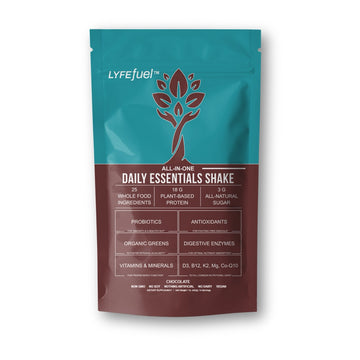
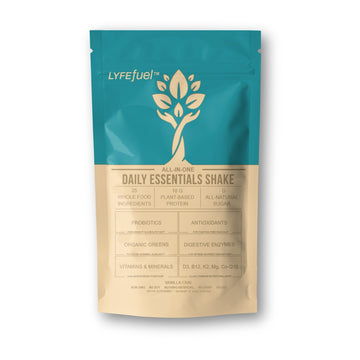
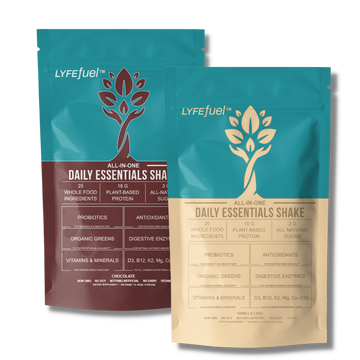
This is the product I built for the exact problem described above. When bariatric patients kept asking for "one thing instead of a dozen pills," I knew what it needed to deliver: complete nutrition, both macros and micros, in a form the body actually absorbs. In a format that's gentle enough for a compromised digestive system.
LyfeFuel Essentials Shake delivers:
| What You Get | Per Serving |
|---|---|
| Plant-based protein | ✅ 18g |
| Vitamins & minerals | ✅ 27 (from whole food sources) |
| Whole food ingredients | ✅ 25+ organic |
| Calories | ✅ 110 |
| Sugar | ✅ 3g |
| Probiotics + digestive enzymes | ✅ Included |
Every micronutrient in Essentials comes from organic whole food sources, not synthetic isolates. That includes methylated B12, D3, K2, a full B-vitamin complex, and minerals sourced from real food. Less than 1% of supplement companies source their micronutrients this way.
Why this profile works for GLP-1 users specifically:
- ✅ 18g of plant-based protein per scoop — helps close the protein gap that leads to muscle loss. Light enough to tolerate when appetite is suppressed. Substantial enough to matter.
- ✅ 110 calories, 3g sugar — nutrient-dense without being calorie-heavy or triggering blood sugar spikes.
- ✅ Whole food-based micronutrients — spanning the exact deficiencies documented in GLP-1 research: vitamin D, B vitamins, iron, calcium, magnesium, zinc.
- ✅ Probiotics and digestive enzymes — support a GI system that's already working differently on GLP-1 therapy.
- ✅ Liquid format — gentler on a slow-emptying stomach than pills, capsules, or heavy meals.
One serving replaces the need for a separate multivitamin, greens powder, protein powder, and probiotic. At $2.92 per serving (or $2.50 on subscription), it consolidates $130–$235/month of individual supplements into one scoop.
It won't sit like a brick.
Get An Exclusive Deal
1000+ Trusted Customer Reviews
- Control Sugar & Junk Food Cravings
- Reboot Your Metabolism
- Nourish Your Gut
- Improve Health Span
- Fill Hard-to-Get Nutrient Gaps
100% No Questions Asked Money Back Guarantee — You're bound to love it! But in that rare case you don't, it's backed by our money-back happiness guarantee.
Frequently Asked Questions
Can I drink a protein shake while on Ozempic or Wegovy?
Yes. The 2025 joint advisory from four major medical societies specifically recommends that GLP-1 users aim for 1.2–2.0 g of protein per kg of body weight daily. Supplemental protein is often necessary since appetite suppression limits food intake. Liquid protein like a shake is generally better tolerated than solid protein when gastric emptying is slowed.
What vitamins should I take on a GLP-1 medication?
Research consistently identifies vitamin D, iron, B vitamins (especially B12 and thiamine), calcium, magnesium, and zinc as the highest-risk deficiencies for GLP-1 users. Rather than buying these individually, a comprehensive whole food-based nutritional shake can cover multiple gaps in a single serving. Easier on your stomach and your budget.
Does Ozempic cause muscle loss?
Not directly, but the calorie restriction caused by GLP-1 medications can include significant lean mass loss: up to 40% of total mass lost in some studies. This happens primarily due to inadequate protein intake. Adequate protein (1.2–1.6 g/kg/day) combined with resistance exercise is the evidence-based approach to preserving muscle and ensuring you're losing fat, not lean tissue.
How much protein do I need on semaglutide or tirzepatide?
Medical guidelines recommend 1.2–2.0 grams of protein per kilogram of body weight daily for people on GLP-1 therapy.
| Your Weight | Minimum (1.2 g/kg) | Optimal (1.6 g/kg) |
|---|---|---|
| 150 lbs (68 kg) | 82g/day | 109g/day |
| 170 lbs (77 kg) | 93g/day | 123g/day |
| 200 lbs (91 kg) | 109g/day | 145g/day |
Most GLP-1 users get 60–80g from food alone, meaning a supplement providing 18–25g per serving can bridge the gap.
Is a meal replacement shake safe with GLP-1 medications?
Yes, provided it doesn't contain stimulants, weight-loss compounds, or excessive added sugars. A nutrient-dense meal replacement can be one of the most practical tools for GLP-1 users. It delivers protein, vitamins, and minerals in a format that's easier to tolerate than a full meal. Always let your prescriber know about any supplements you're taking.
Will a nutritional shake be too heavy on my stomach while on Ozempic?
This is one of the most common concerns, and a legitimate one. GLP-1 medications slow gastric emptying, which means heavy, thick shakes can cause discomfort. Look for options that are low-calorie (under 150 calories), low-sugar, and include digestive enzymes. Mixing with more water for a thinner consistency also helps. LyfeFuel Essentials at 110 calories and 3g sugar is designed to be light and digestible.
What's the difference between synthetic vitamins and whole food-based vitamins?
Most supplements use synthetic vitamin forms manufactured from industrial precursors, often derived from petroleum or coal tar. Whole food-based vitamins are derived from actual food sources and retain the natural cofactors (enzymes, companion nutrients) that support absorption. For GLP-1 users whose digestive absorption is already altered, whole food-sourced nutrients may offer a bioavailability advantage. Your body recognizes and processes them more readily.
How much do GLP-1 supplement stacks typically cost?
Individual supplements recommended for GLP-1 users (protein, multivitamin, vitamin D, iron, B12, collagen, magnesium, electrolytes) typically total $130–$235 per month when purchased separately. An all-in-one nutritional shake like LyfeFuel Essentials consolidates most of these at $60/month on subscription ($2.50/serving).
The Bottom Line
GLP-1 medications are genuinely effective. They're helping millions of people achieve meaningful improvements in metabolic health.
But the research is increasingly clear: eating less without a deliberate nutritional strategy creates real deficiency risk. Vitamin D. Iron. B vitamins. Calcium. And especially protein.
I've seen what happens when this problem goes unaddressed. I spent years watching it play out in bariatric patients. The ones who took their nutrition seriously achieved genuine, sustainable fat loss and kept their energy, their muscle, and their quality of life. The ones who didn't, struggled.
GLP-1 users have the same opportunity and the same risk. The good news is that this is a solvable problem. Not by adding eight bottles to your medicine cabinet, but by being intentional about getting the most nutrition possible from the least volume of food.
Your appetite may have left. Your nutrition doesn't have to.
Get An Exclusive Deal
1000+ Trusted Customer Reviews
- Control Sugar & Junk Food Cravings
- Reboot Your Metabolism
- Nourish Your Gut
- Improve Health Span
- Fill Hard-to-Get Nutrient Gaps
100% No Questions Asked Money Back Guarantee — You're bound to love it! But in that rare case you don't, it's backed by our money-back happiness guarantee.
LyfeFuel Essentials Shake is a food-based nutritional supplement. It is not intended to diagnose, treat, cure, or prevent any disease. These statements have not been evaluated by the Food and Drug Administration. If you are currently taking GLP-1 medications, consult your healthcare provider before starting any new supplement.
Sources
- Urbina J, et al. "Micronutrient and Nutritional Deficiencies Associated With GLP-1 Receptor Agonist Therapy: A Narrative Review." Clinical Obesity. 2026;16(1):e70070. PMID: 41549912
- Butsch WS, et al. "Nutritional deficiencies and muscle loss in adults with type 2 diabetes, prediabetes, and obesity treated with GLP-1 receptor agonists." Obesity Pillars. 2025. PMC12205620
- Johnson B, et al. "Investigating nutrient intake during use of glucagon-like peptide-1 receptor agonist: a cross-sectional study." Frontiers in Nutrition. 2025. DOI: 10.3389/fnut.2025.1566498
- "Nutritional priorities to support GLP-1 therapy for obesity: A joint advisory from ACLM, ASN, OMA, and TOS." Obesity Pillars. 2025;15:100181. PMID: 40445127
- Harvard Health Publishing. "Study: Taking GLP-1 drugs may increase risk of key nutrient deficiencies." March 18, 2026. harvard.edu
- Gasoyan H, et al. "Reasons for Discontinuation of Injectable Semaglutide and Tirzepatide for Obesity." Cleveland Clinic. clevelandclinic.org
- Truveta Research. "ISPOR 2025: Real-world temporal and indication-specific variation in drivers of GLP-1 RA discontinuation." 2025. truveta.com